North Seymour Island Tour – Galápagos’ Premier Seabird Colony
North Seymour Island is one of the most extraordinary wildlife destinations in the Galápagos archipelago, and a must-visit from Santa Cruz. This small, flat island — uplifted from the ocean floor by tectonic activity rather than volcanic eruption — hosts the largest colony of nesting Magnificent Frigatebirds in the Galápagos, alongside Blue-footed Boobies, Galápagos land iguanas, and sea lions, all in an astonishingly compact and accessible setting. Nowhere else in the islands can you observe so many iconic Galápagos species in such close proximity within a single two-hour visit.
Magnificent Frigatebirds — The Red Balloon Display
The defining spectacle of North Seymour is the Magnificent Frigatebird breeding colony. Male frigatebirds in breeding season inflate their scarlet throat pouches to the size of a volleyball — a dramatic, iridescent red balloon that pulsates as they call out to attract females flying overhead. Females are striking in their own right: pure black with a distinctive white chest. On North Seymour, frigatebirds nest just centimeters from the visitor trail, allowing photography at close distances impossible in almost any other location on Earth. Chicks (fluffy white, almost comically large) are visible in the nests from approximately January to June.
Blue-footed Boobies — Courtship Dances
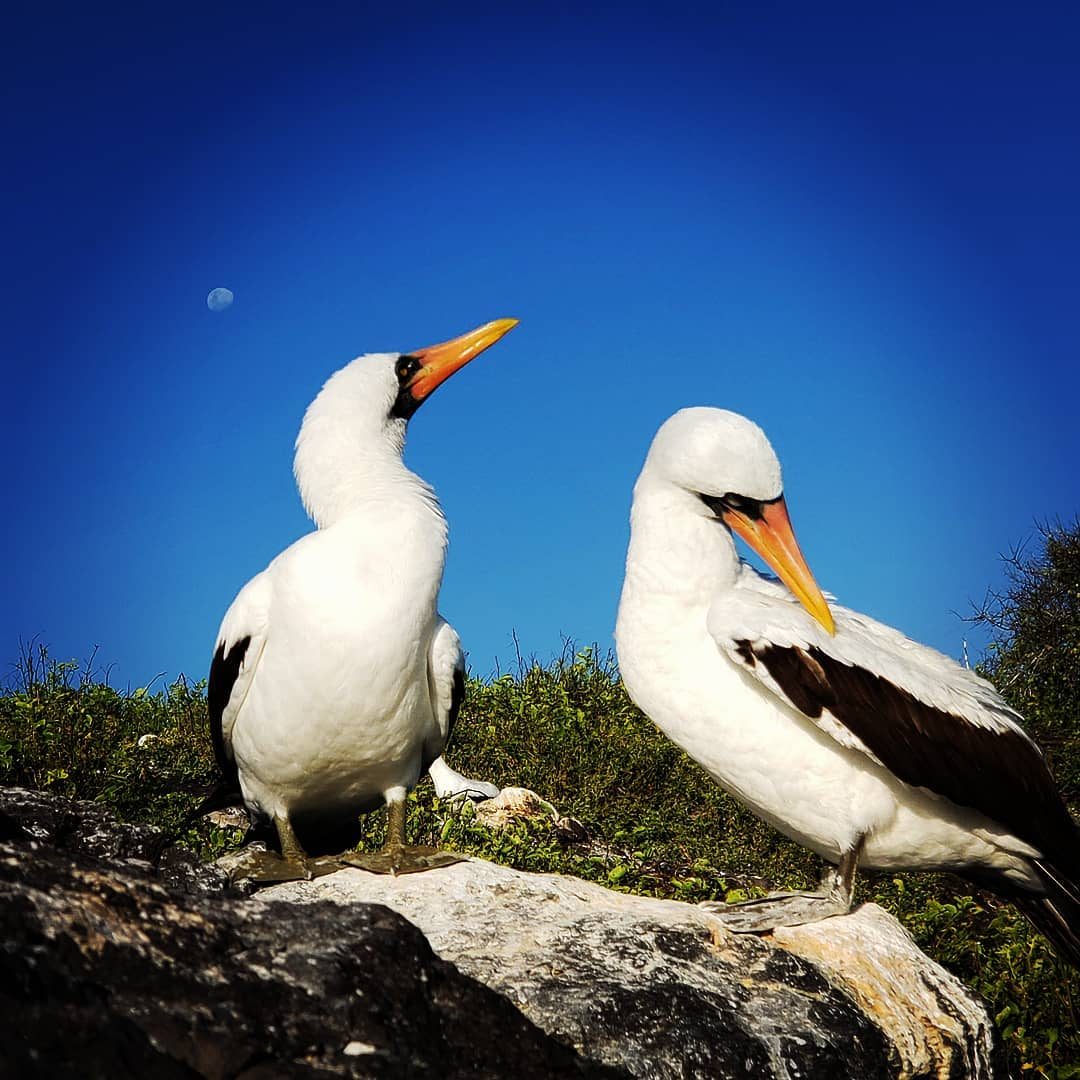
North Seymour also hosts an active Blue-footed Booby nesting colony where the famous courtship behavior is easily observed. During nesting season, the males perform their iconic high-stepping “blue feet parade” on the trail itself — occasionally requiring visitors to stop and wait while a particularly enthusiastic male dances at their feet. The vivid blue of a mature male’s feet is one of the most intensely colored natural phenomena in the bird world, and signals fitness to potential mates.
Land Iguanas & Sea Lions
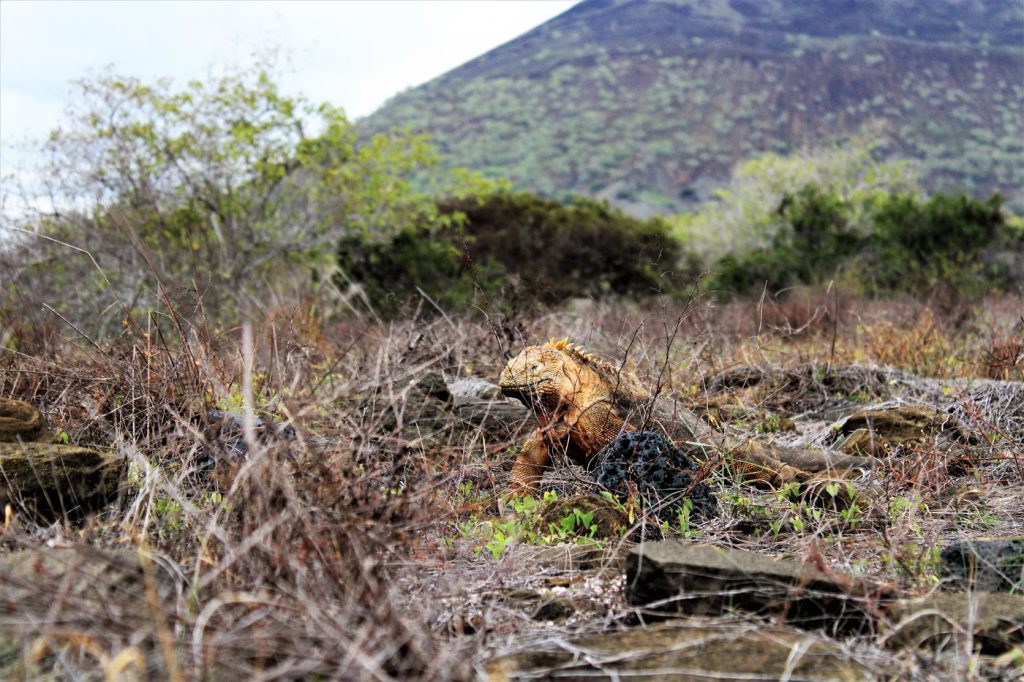
The interior of North Seymour is home to a population of Galápagos land iguanas relocated from nearby Baltra Island after habitat destruction in the mid-20th century. These golden-yellow reptiles, some weighing up to 13 kg, are the largest lizards in the Galápagos and feed almost exclusively on prickly pear cactus. Along the shoreline, a permanent colony of Galápagos sea lions occupies the small sandy beach — pups and mothers resting in the shade of salt bushes, bulls patrolling the water’s edge.
Wildlife Summary
- Magnificent Frigatebirds — largest colony in Galápagos, males with inflated red pouches
- Blue-footed Boobies — nesting on the trail itself during breeding season
- Galápagos land iguanas — golden-yellow, up to 1.5 m long
- Galápagos sea lions — beach colony on the northern shore
- Swallow-tailed Gulls — the world’s only nocturnal gull, roosting on the island
- Lava gulls — the rarest gull in the world, often sighted here
- Marine iguanas — large population on the rocky coastal areas
What’s Included
- Boat transport from Puerto Ayora (Santa Cruz) to North Seymour and return
- Certified bilingual naturalist guide
- Galápagos National Park entrance fee for North Seymour
- Snorkeling equipment (snorkeling opportunities on the return route)
- Drinking water and snacks
Practical Information
Duration: Approximately 5–6 hours (including 1.5–2 hours walking on the island).
Difficulty: Easy. Flat terrain on well-maintained crushed lava trail. Suitable for all ages.
Best season: Year-round. Frigatebird pouch displays are most intense April–August; Booby chicks are visible January–June.
What to bring: Sun protection (no shade on the island), comfortable walking shoes, camera with zoom lens for bird photography.
Frequently Asked Questions
How close can we get to the wildlife?
Galápagos National Park rules require a 2-meter minimum distance from wildlife. In practice, the animals on North Seymour often come CLOSER than 2 meters to visitors of their own accord. Your guide ensures no wildlife is disturbed.
Is North Seymour the same as Baltra?
No — they are adjacent islands. Baltra is the location of the main airport serving Santa Cruz. North Seymour is a separate wildlife visitor site, approximately 20 minutes by boat from Puerto Ayora.