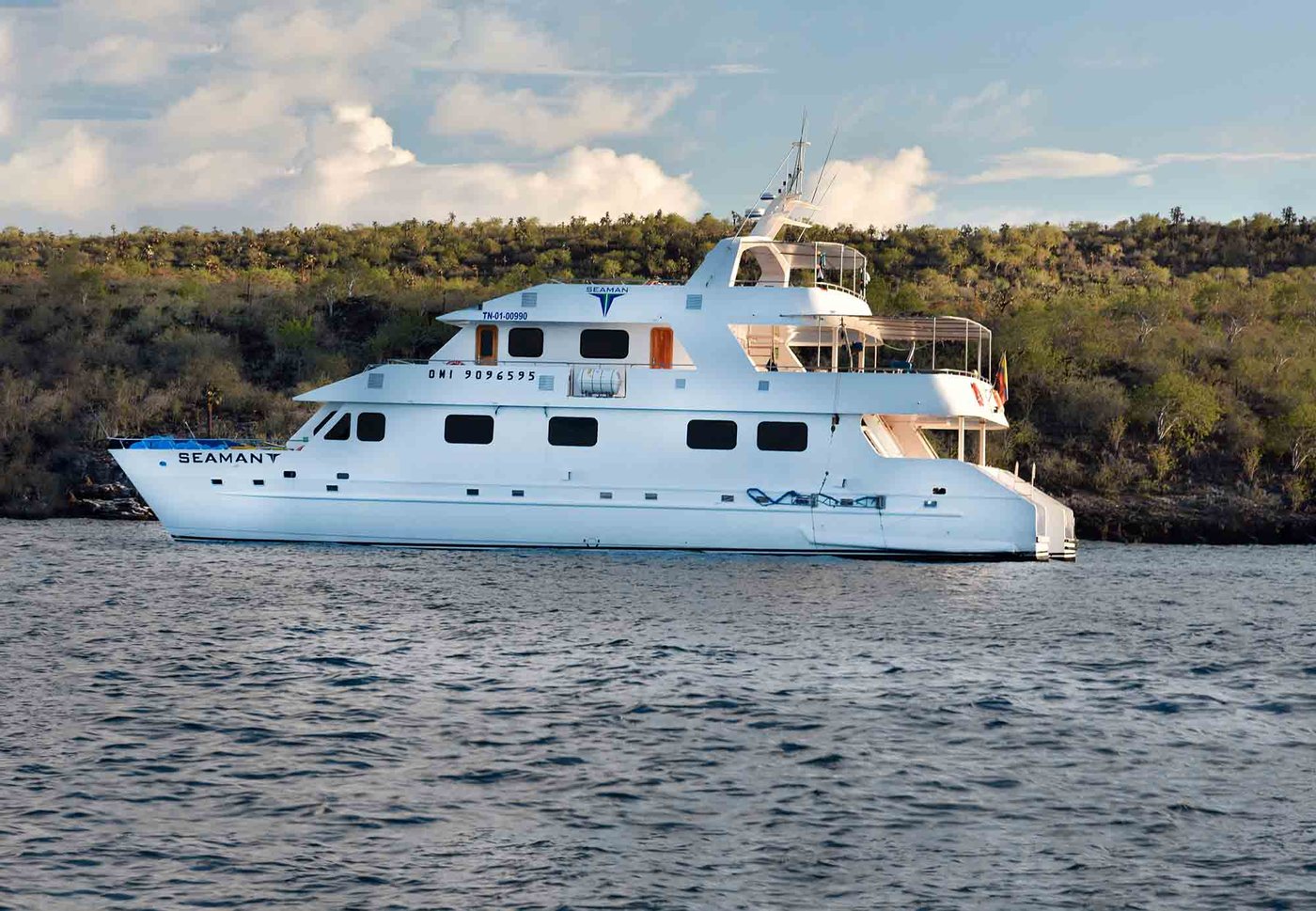
A sleek, twin – hulled catamaran, it provides its guests with a steady, safe cruise without the rocking and swaying common to the older, single – hulled yachts that dominated the island cruise industry for decades.
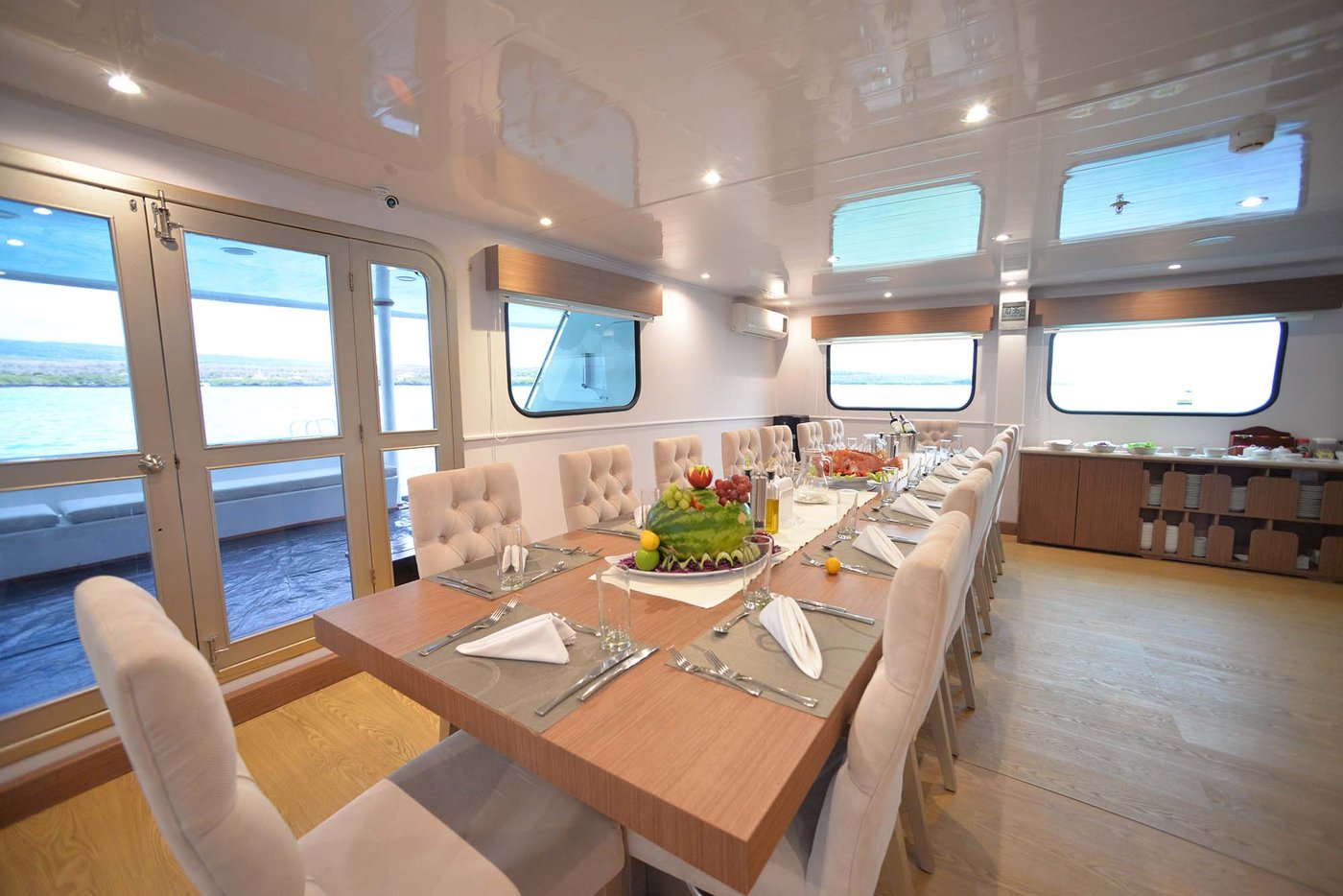
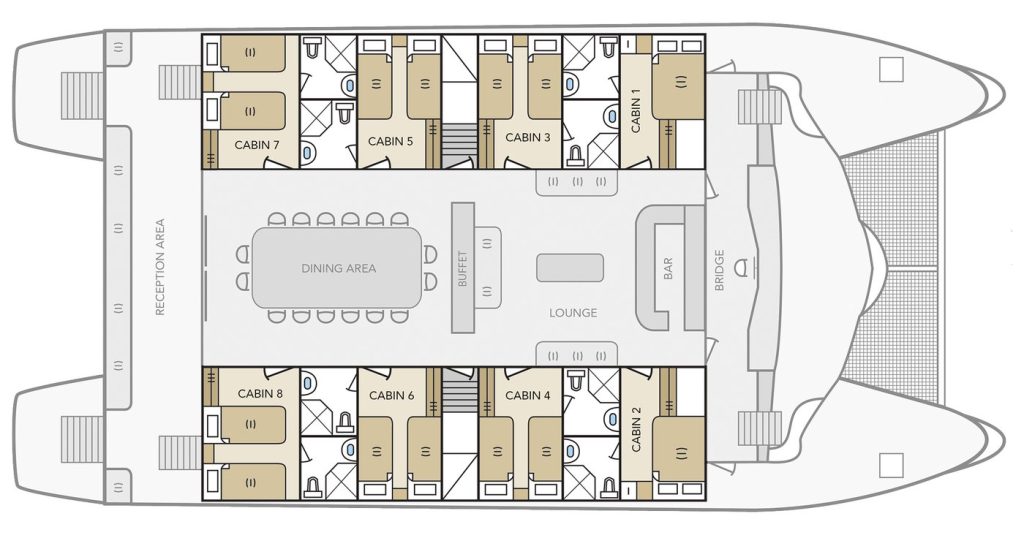
All suites can have one queen – sized or two single beds. We are particularly proud of the panoramic windows featured in each suite: unlike the heavy, round porthole windows of the older yachts, each suite on the Elite has grand windows offering panoramic views. They are not even windows, exactly: think of them more as a wall of tempered glass, with a door to get to your balcony. Each morning and afternoon brings a different stunning Galapagos seascape! Guests greatly enjoy meals served on board the Elite. Our professional cuisine specialists prepare three delicious, nutritious meals per day: breakfast and mainly lunch are served buffet – style, with a more elegant sit-down dinner served in the al fresco dining area on the partially covered sky deck.
Elite Galapagos Cruise Itineraries
-
ITINERARY (A): 7 days, 8 nights
-
ITINERARY (B): 7 days, 8 nights
-
ITINERARY (C): 3 days, 4 nights
-
ITINERARY (D): 4 days, 5 nights
Saturday AM:
Arrive at San Cristobal airport.
Saturday PM:
El Junco Lagoon
Walk up the rocky path surrounded by rich vegetation and wildlife to the rim of the El Junco Lagoon, an impressive crater lake located in the highlands of San Cristobal island. Here you will enjoy superb panoramic views of the island, and you can often catch frigate birds diving and bathing in the crystal clear water
Sunday AM:
North Seymour
North Seymour island is a small island named after Lord Hugh Seymour, a senior British Royal Navy officer. Walking amongst the low, bushy vegetation you will be able to observe a large variety of birds, including blue-footed boobies, swallow tailed gulls and a large population of frigate birds.
Look out for the marvelous bright red chests of the male frigates used to attract a mate.
Sunday PM:
Santa Cruz Dragon Hill
The name Dragon Hill refers to the large population of Galapagos land iguanas that have made their home here. As you walk along the rocky coastline and through the forests of cacti and Palo Santo trees, you will no doubt encounter a number of these incredible creatures that resemble miniature dragons.
The high tide also makes this a fantastic place to snorkel as the coral attracts a plethora of colourful fish close to the shoreline.
Monday AM:
Tintoreras / Sierra Negra Volcano
Las Tintoreras is a chain of islets off the coast of Isabela island that are characterised by dark lava formations and have created a unique habitat for a variety of wildlife. It is therefore a fantastic site for water activities such as a panga ride, snorkelling, kayaking or paddle boarding and visitors are often treated to close-up sightings of turtles, sharks, penguins and sea lions.
The Sierra Negra is one of the most active volcanoes in the Galapagos and has the second largest caldera in the world. As you walk up to the top of the caldera you will encounter forests of guava trees and on a clear day you will be treated to spectacular views of the other five volcanoes on the island.
Monday PM:
Arnaldo Tupiza Breeding Center / Isabela Wetlands
The Arnaldo Tupiza Breeding Center, where two species of giant tortoise are bred to increase the population of these incredible animals, plays an essential role in protecting the future of the Galapagos.
As you walk around the centre you will also be able to enjoy the beautiful gardens that boast of a wide variety of native plants.
Just outside Puerto Villamil you can also take a walk around the Isabela wetlands, comprised of lagoons, swamps and mangroves, which have become a paradise for migratory birds such as stilts and flamingos.
Tuesday AM:
Isabela / Moreno Point
Moreno point is located on the west coast of Isabela island and although it appears a barren lava flow at first, a walk along one of the trails soon reveals a multitude of beautiful green lagoons and mangroves and is a fantastic place to see penguins, blue herons and flamingos.
Meanwhile, a panga ride or snorkel along the rocky shoreline is a wonderful way to spot green sea turtles and white-tip sharks.
Tuesday PM:
Isabela / Urbina Bay
Urbina Bay is located at the foot of the Alcedo Volcano and is the result of a major volcanic uplift that took place in 1954 and resulted in 6km of coral reef being lifted out of the ocean. Walking along this new shore, you can observe the corals and remains of marine life that were stranded due to this event.
However, it is now home to giant land iguanas and giant tortoises and it often a good spot to see Galapagos hawks and flightless cormorants. It is also ideal for snorkeling as turtles, rays and tropical fish frequent the coastline.
Wednesday AM:
Fernandina / Espinosa Point
Fernandina is the youngest island in the Galapagos and Espinosa point is a wonderful area of natural beauty. Snorkeling and swimming from the zodiac allows you see thee marine iguanas feeding underwater.
On the rocks you will often see large numbers of colourful Sally Lightfoot crabs. On land, the walking trails enable you to explore the fascinating mangrove plants, lava cacti and striking black lava formations where marine iguanas enjoy basking themselves in the sun.
Wednesday PM:
Isabela / Vicente Roca Point
Accessible by panga, Vicente Roca Point on the north west coast of Isabela island is a beautiful large bay with two coves that provide nesting sites for blue-footed and Nazca boobies, gulls, storm petrels and Brown Noddy Terns.
Snorkeling is also a great activity here as the cooler waters result in an abundance of food for marine life, and it is common to see groups of whales, dolphins, sea lions and marine birds gorging themselves.
Thursday AM:
Rabida
Rabida island is most known for its dark red sand beach surrounded by a backdrop of cliffs and steep volcanic hills full of Palo Santo trees and endemic cacti.
A panga ride around the shoreline gives the chance to spot blue-footed and nazca boobies and water activities such as snorkeling, kayaking or paddle boarding are ideal for seeing white tipped sharks and rays.
On the beach you will find a large noisy colony of sea lions and the surrounding salt brush is home to a nesting colony of pelicans. Inland, bird watchers will delight in seeing mockingbirds, yellow warblers and Darwin finches – Rabida is the only site where all nine Darwin’s finches are found.
Thursday PM:
Bartholomew Island
Bartholomew island is an islet located in Sullivan Bay and its most famous landmark is a huge volcanic cone named Pinnacle Rock. A walking trail leads up to a viewpoint at the summit of the island where you can enjoy spectacular views of Pinnacle Rock and the surrounding lava flows.
The northern beach, a nesting site for green sea turtles, is perfect for snorkeling where sightings of spotted eagle rays, penguins and reef sharks are possible.
Friday AM:
Kicker Rock / Witch Hill
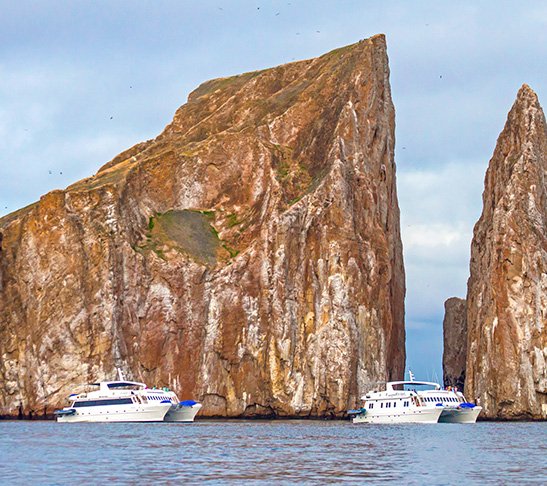
They say your culture influences the way you look at things, and Kicker Rock may just be the proof of that. Kicker Rock is a distinctive, boot-shaped rock formation located off of San Cristobal Island. In English, it gets its name from this shape. In Spanish, its name is “León Dormido,” or “Sleeping Lion.” Does it look more like a boot or a lion? You’ll get a nice close-up chance to look for yourself and make up your mind.
Witch Hill features an idyllic white sand beach which can be accessed by panga and is a superb vantage point for seeing Kicker Rock in the south of the island. The hill itself is an eroded tuff cone and the calm waters at the base of it offer a magnificent spot for snorkeling.
Meanwhile, a walk along the beach or on one of the inland paths, provides opportunities to see a variety of shore birds, finches and mockingbirds.
Friday PM:
Giant Tortoises’ Reserve, off San Cristobal
The visit to the Giant Tortoise’s Reserve is the longest hike on San Cristobal; the walk is about 5 km one way and may be quite hot.
This is an excellent site for observing giant tortoises in their natural habitat. San Cristobal has a population of six thousand giant tortoises; in a good day, hundreds of them can be seen along with other endemic species, such as lava lizards, and mockingbirds.
Snorkel is a great activity as you have opportunities to see sea turtles and tintoreras (white tipped reef sharks). The beach of this visitor site is a nesting area for sea turtles.
Saturday AM:
San Cristobal Interpretation Center
A short distance from the centre of San Cristobal is the San Cristobal Interpretation Center, which provides an overview of the fascinating history of the islands. The main areas of focus, which are addressed through a number of expositions are: natural history, human history and conservation for the future.
You can also take one of the trails behind the center that lead to some great viewpoints of the ocean and volcanic rocks below.
Saturday PM:
San Cristobal Airport
Depart from San Cristobal airport.
Saturday AM:
Arrive at San Cristobal airport.
Saturday PM:
David Rodriguez Breeding Center
A visit to the David Rodriguez Breeding Center provides information about the origin and evolution of the giant tortoise and explains why the center is so vital in safeguarding the future of these incredible creatures.
Walking through the trails of the reserve, you can see baby tortoises being reared in semi-natural conditions – a brilliant demonstration of the commitment the local people have to preserving the wildlife that makes the Galapagos so special.
Sunday AM:
Española / Suarez Point
Suarez Point is packed with wildlife and is best explored by following the circular walking trail. This memorable walk will take you past nesting sites of large colonies of nazca and blue-footed boobies and mockingbirds.
Unique to Española island are also the beautiful waved albatross, that can be seen majestically launching themselves out across the ocean from the cliffs and the red and green marine iguanas.
A geological highlight are several blow holes, capable of shooting water 25m into the air, that make for a spectacular photo.
Sunday PM:
Gardner Bay, Gardner and Osborn Islet
The pristine white sandy beach of Gardner Bay dotted with sea lions provides a perfect spot to relax and kayaking or paddle boarding is a fantastic way to observe the large number of waved albatross who use this beach as a breeding site.
A short panga ride will take you to the Gardner and Osborn Islets, which are superb locations for snorkeling with young sea lions and a variety of colourful tropical fish and corals.
Monday AM:
Floreana – Cormorant Point / Devil’s Crown
Cormorant Point features two contrasting beaches: one with olive-green sand due to the high content of olivine crystals, and another with pure white sand (commonly known as ‘Flour Beach’) derived from pulverized coral.
The saltwater pond is a must-see as it is frequented by one of the archipelago’s largest populations of Galapagos flamingos as well as other shorebirds such as stilts, white-cheeked pintails and large-billed flycatchers.
Afterwards, guests will take a zodiac ride to Devil´s Crown, an underwater volcanic crater that is almost completely submerged – in fact, just a small portion of the rock formation can be seen from above, and it looks like a crown. Snorkelers will discover a vast underwater world full of coral reefs and a myriad of marine species. Birds are also part of this visitor point due to its location in open waters.
Monday PM:
Post Office Bay / The Baroness’ Lookout
Post Office Bay is a man-made site that offers an insight into a remarkable mailing tradition developed by British whalers in the 18th century, that visitors can still take part in today. The beach here provides for good snorkeling and kayaking and it is also possible to descend into and walk through a lava tube.
Next, take a panga ride to the Baroness’ Lookout, a volcanic rock formation named after an Australian baroness, who visited the island in the 1930’s and is believed to have mysteriously disappeared.
A short trail leads to a brilliant vantage point with panoramic views of the surrounding mangroves and coastline.
Tuesday AM:
Baltra / Mosquera Islet
Mosquera islet is a small, flat, sandy islet located between Baltra and North Seymour islands.
With no fixed trail, you are free to explore the beautiful surroundings on foot, where you will encounter a large population of sea lions, shorebirds and the striking Sally Lightfoot crabs that cling to the dark rocks.
The numerous coral reefs also make it a fantastic site for snorkeling and catching sight of a range of marine life including sharks, turtles and rays.
Tuesday PM:
Santa Cruz – Bachas Beach
Bachas Beach is a beautiful white-sand beach on which the remnants of a rusted barge, thought to have been abandoned by the Americans during WWI, can be seen. It is a popular nesting site for turtles, so if you go for a snorkel, you might find yourself sharing the water with these wonderful creatures.
The beach is also full of vibrant Sally Lightfoot and hermit crabs, and elegant pink flamingos that frequent the saltwater pond located just behind the beach.
Wednesday AM:
Genovesa – Prince Philip’s Steps / El Barranco
El Barranco, also known as Prince Philip’s Steps, is a rocky stairway that will lead you past a colony of nazca and red-footed boobies leads up to a plateau of dried lava. Continuing through the thin Palo Santo forest and looking out over the plain, visitors are often treated to sites of storm petrels launching out over the ocean.
A panga ride or kayaking/paddle boarding along the edge of the cliffs provides a good chance to see the elusive Galapagos fur seals nestled on the rocks, and snorkeling is a great activity if you fancy a dip with a variety of shark species.
Wednesday PM:
Genovesa / Darwin Bay
Darwin Bay has a small sand and coral beach that provides the perfect spot for snorkeling, kayaking or paddle boarding in calm, sheltered waters in the company of hammerhead sharks, rays and a plethora of colourful reef fish. Onshore, a short trail leads along a tidal lagoon and mangroves, home to a variety of land bird species, including Nazca and red-footed boobies and swallow-tailed gulls.
The trail culminates at a viewpoint that offers a stunning view overlooking the cliffs and the bay below.
Thursday AM:
Santiago – Espumilla Beach / Buccaneer Cove
Espumilla beach, located on the northern coast of Santiago island, is an exquisite white sand beach, whose name refers to the meringue-like trails of foam left by the lapping of the waves. Sally Lightfoot crabs are in abundance here and as a result, it is common to see predatory birds such as hawks, herons and pelicans.
This idyllic location is perfect for snorkeling or kayaking/paddle boarding amongst a raft of marine life, including species of octopus, eels and sharks. Buccaneer Cove has an interesting history as it is where sailors, buccaneers and whalers frequently anchored their vessels in search for food and water. In more recent times it has become an important nesting site for turtles and is also popular with sea lions.
A panga ride along the eroded shoreline provides views of intriguing rock formations that provide excellent ledges for boobies, pelicans and gulls.
Thursday PM:
Egas Port
Egas Port was once the site of a salt mine, but now this impressive black sand beach is an excellent location for snorkeling and observing shorebirds, Sally Lightfoot crabs and marine iguanas.
A stroll along the wide trails inland leads you past tidal pools and rocky volcanic formations known as grottoes where it is possible to spot fur seals enjoying a spot of shade.
Friday AM:
Black Turtle Cove
The first visit of the day is to Black Turtle Cove, which is located on the north shore of Santa Cruz. It is a living illustration of how mangroves alter the marine environment to create a rich and unique habitat. Three mangrove species crowd the area from the shore out into a shallow lake which reaches almost a mile inland.
As you drift through quiet waters in the zodiac, you are likely to see spotted eagle rays and diamond-shaped mustard rays, which swim in a diamond formation. White-tipped reef sharks slip beneath the boat and Pacific green sea turtles come to the surface for air and to mate. Waterfowl, including pelicans, herons and egrets, all feed in the cove. It’s a peaceful place where visitors often have up-close encounters with Galapagos wildlife, often making it a highlight of the trip!
Friday PM:
Highlands and Charles Darwin Research Station
On the highlands of Santa Cruz, you’ll have the opportunity to see the famous giant tortoises in the wild. So renowned are these endemic animals that they gave the archipelago its name. Birdwatching is also one of the activities do to in the Santa Cruz highlands, since this area is home of finches and other Galapagos birds.
After the visit to the highlands, we continue to the famous Charles Darwin Research Station that provides guests with a unique opportunity to find out about the vital work that is being carried out to preserve the archipelago’s ecosystems.
The Research Center is also home to a significant breeding program for Galapagos tortoises, whose numbers have been in decline since the 1970’s.
These captivating reptiles are very accustomed to humans, so be sure to bring your camera for some close-ups.
Saturday AM:
Lobos Island / San Cristobal
Accessed by panga, Lobos island gets its name from the herds of sea lions that have made their home here.
Snorkeling in the calm clear water provides a unique opportunity to see these inquisitive and playful animals up close and it is also common to be accompanied by green turtles and rays as well.
Inland there is a trail where you can expect to encounter nesting sites for blue-footed boobies and frigates.
Saturday:
San Cristobal Airport
Depart from San Cristobal Airport.
Saturday AM:
Arrive at San Cristobal airport.
Saturday PM:
David Rodriguez Breeding Center
A visit to the David Rodriguez Breeding Center provides information about the origin and evolution of the giant tortoise and explains why the center is so vital in safeguarding the future of these incredible creatures.
Walking through the trails of the reserve, you can see baby tortoises being reared in semi-natural conditions – a brilliant demonstration of the commitment the local people have to preserving the wildlife that makes the Galapagos so special.
Sunday AM:
Española / Suarez Point
Suarez Point is packed with wildlife and is best explored by following the circular walking trail. This memorable walk will take you past nesting sites of large colonies of nazca and blue-footed boobies and mockingbirds.
Unique to Española island are also the beautiful waved albatross, that can be seen majestically launching themselves out across the ocean from the cliffs and the red and green marine iguanas.
A geological highlight are several blow holes, capable of shooting water 25m into the air, that make for a spectacular photo.
Sunday PM:
Gardner Bay, Gardner and Osborn Islet
The pristine white sandy beach of Gardner Bay dotted with sea lions provides a perfect spot to relax and kayaking or paddle boarding is a fantastic way to observe the large number of waved albatross who use this beach as a breeding site.
A short panga ride will take you to the Gardner and Osborn Islets, which are superb locations for snorkeling with young sea lions and a variety of colourful tropical fish and corals.
Monday AM:
Floreana – Cormorant Point / Devil’s Crown
Cormorant Point features two contrasting beaches: one with olive-green sand due to the high content of olivine crystals, and another with pure white sand (commonly known as ‘Flour Beach’) derived from pulverized coral.
The saltwater pond is a must-see as it is frequented by one of the archipelago’s largest populations of Galapagos flamingos as well as other shorebirds such as stilts, white-cheeked pintails and large-billed flycatchers.
Afterwards, guests will take a zodiac ride to Devil´s Crown, an underwater volcanic crater that is almost completely submerged – in fact, just a small portion of the rock formation can be seen from above, and it looks like a crown. Snorkelers will discover a vast underwater world full of coral reefs and a myriad of marine species. Birds are also part of this visitor point due to its location in open waters.
Monday PM:
Post Office Bay / The Baroness’ Lookout
Post Office Bay is a man-made site that offers an insight into a remarkable mailing tradition developed by British whalers in the 18th century, that visitors can still take part in today. The beach here provides for good snorkeling and kayaking and it is also possible to descend into and walk through a lava tube.
Next, take a panga ride to the Baroness’ Lookout, a volcanic rock formation named after an Australian baroness, who visited the island in the 1930’s and is believed to have mysteriously disappeared.
A short trail leads to a brilliant vantage point with panoramic views of the surrounding mangroves and coastline.
Tuesday AM:
Baltra / Mosquera Islet
Mosquera islet is a small, flat, sandy islet located between Baltra and North Seymour islands.
With no fixed trail, you are free to explore the beautiful surroundings on foot, where you will encounter a large population of sea lions, shorebirds and the striking Sally Lightfoot crabs that cling to the dark rocks.
The numerous coral reefs also make it a fantastic site for snorkeling and catching sight of a range of marine life including sharks, turtles and rays.
Tuesday PM:
Santa Cruz – Baltra Airport
Transfer from the yacht to the airport.
Tuesday AM:
Baltra Airport – Arrive at Baltra Airport.
Tuesday PM:
Santa Cruz – Bachas Beach
Bachas Beach is a beautiful white-sand beach on which the remnants of a rusted barge, thought to have been abandoned by the Americans during WWI, can be seen. It is a popular nesting site for turtles, so if you go for a snorkel, you might find yourself sharing the water with these wonderful creatures.
The beach is also full of vibrant Sally Lightfoot and hermit crabs, and elegant pink flamingos that frequent the saltwater pond located just behind the beach.
Wednesday AM:
Genovesa – Prince Philip’s Steps / El Barranco
El Barranco, also known as Prince Philip’s Steps, is a rocky stairway that will lead you past a colony of nazca and red-footed boobies leads up to a plateau of dried lava. Continuing through the thin Palo Santo forest and looking out over the plain, visitors are often treated to sites of storm petrels launching out over the ocean.
A panga ride or kayaking/paddle boarding along the edge of the cliffs provides a good chance to see the elusive Galapagos fur seals nestled on the rocks, and snorkeling is a great activity if you fancy a dip with a variety of shark species.
Wednesday PM:
Genovesa / Darwin Bay
Darwin Bay has a small sand and coral beach that provides the perfect spot for snorkeling, kayaking or paddle boarding in calm, sheltered waters in the company of hammerhead sharks, rays and a plethora of colourful reef fish. Onshore, a short trail leads along a tidal lagoon and mangroves, home to a variety of land bird species, including Nazca and red-footed boobies and swallow-tailed gulls.
The trail culminates at a viewpoint that offers a stunning view overlooking the cliffs and the bay below.
Thursday AM:
Santiago – Espumilla Beach / Buccaneer Cove
Espumilla beach, located on the northern coast of Santiago island, is an exquisite white sand beach, whose name refers to the meringue-like trails of foam left by the lapping of the waves. Sally Lightfoot crabs are in abundance here and as a result, it is common to see predatory birds such as hawks, herons and pelicans.
This idyllic location is perfect for snorkeling or kayaking/paddle boarding amongst a raft of marine life, including species of octopus, eels and sharks. Buccaneer Cove has an interesting history as it is where sailors, buccaneers and whalers frequently anchored their vessels in search for food and water. In more recent times it has become an important nesting site for turtles and is also popular with sea lions.
A panga ride along the eroded shoreline provides views of intriguing rock formations that provide excellent ledges for boobies, pelicans and gulls.
Thursday PM:
Egas Port
Egas Port was once the site of a salt mine, but now this impressive black sand beach is an excellent location for snorkeling and observing shorebirds, Sally Lightfoot crabs and marine iguanas.
A stroll along the wide trails inland leads you past tidal pools and rocky volcanic formations known as grottoes where it is possible to spot fur seals enjoying a spot of shade.
Friday AM:
Black Turtle Cove
The first visit of the day is to Black Turtle Cove, which is located on the north shore of Santa Cruz. It is a living illustration of how mangroves alter the marine environment to create a rich and unique habitat. Three mangrove species crowd the area from the shore out into a shallow lake which reaches almost a mile inland.
As you drift through quiet waters in the zodiac, you are likely to see spotted eagle rays and diamond-shaped mustard rays, which swim in a diamond formation. White-tipped reef sharks slip beneath the boat and Pacific green sea turtles come to the surface for air and to mate. Waterfowl, including pelicans, herons and egrets, all feed in the cove. It’s a peaceful place where visitors often have up-close encounters with Galapagos wildlife, often making it a highlight of the trip!
Friday PM:
Highlands and Charles Darwin Research Station
On the highlands of Santa Cruz, you’ll have the opportunity to see the famous giant tortoises in the wild. So renowned are these endemic animals that they gave the archipelago its name. Birdwatching is also one of the activities do to in the Santa Cruz highlands, since this area is home of finches and other Galapagos birds.
After the visit to the highlands, we continue to the famous Charles Darwin Research Station that provides guests with a unique opportunity to find out about the vital work that is being carried out to preserve the archipelago’s ecosystems.
The Research Center is also home to a significant breeding program for Galapagos tortoises, whose numbers have been in decline since the 1970’s.
These captivating reptiles are very accustomed to humans, so be sure to bring your camera for some close-ups.
Saturday AM:
Lobos Island / San Cristobal
Accessed by panga, Lobos island gets its name from the herds of sea lions that have made their home here.
Snorkeling in the calm clear water provides a unique opportunity to see these inquisitive and playful animals up close and it is also common to be accompanied by green turtles and rays as well.
Inland there is a trail where you can expect to encounter nesting sites for blue-footed boobies and frigates.
Saturday:
San Cristobal Airport
Depart from San Cristobal Airport