
With nearly 300,000 visitors, Ecuador’s archipelago faces environmental pressures that threaten a unique place on the planet. How can sustainable growth be ensured in a destination that depends on tourism to survive?
The dilemma is turning people against one another, but it cannot last much longer.
Marine iguanas crossing the sand in front of attentive beachgoers, and giant tortoises or sea lions pursued by curious onlookers, are not sights you see every day. But this is the Galápagos. With 97% of the islands classified as a natural reserve, the chances of encountering exotic wildlife increase dramatically.
Close encounters between humans and wildlife, however, go beyond the unusual. The local press reports more trash on beaches, visitors walking through protected areas without guides, and growing pressure on sewage and urban waste management, freshwater supplies, and energy consumption. With nearly 300,000 visitors, mass tourism has arrived in this Ecuadorian archipelago with bags and baggage — and it is setting people against one another.
“THE PEOPLE HERE ARE ESSENTIAL TO KEEP THIS PLACE SAFE, PROSPEROUS, AND AUTHENTIC.”
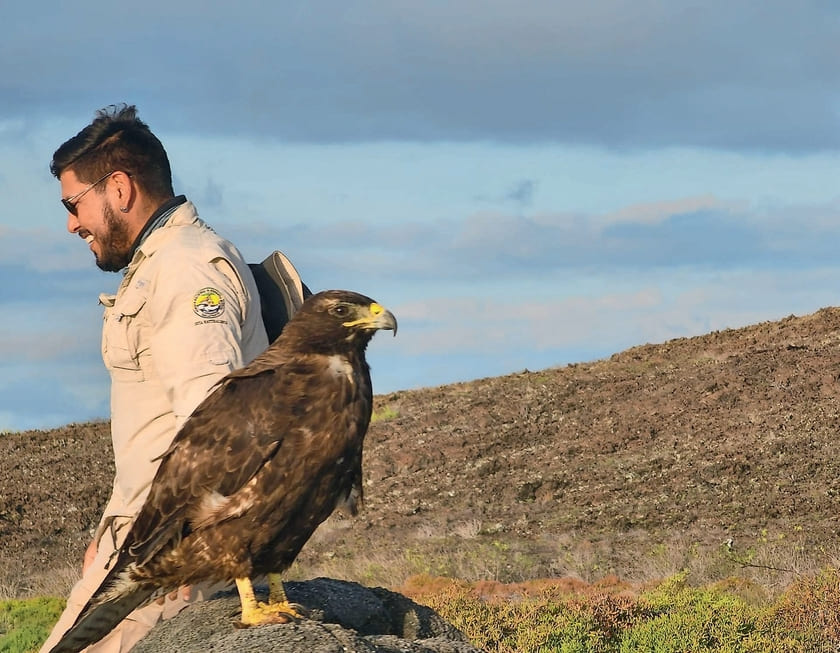
Marco Andrés Vizcaino García, born into a family of Galápagos fishermen, discovered his vocation at age 15 while volunteering at a giant tortoise breeding center. Now working as a naturalist guide on the island of San Cristóbal Island, he believes that supporting local communities is the path to protecting the archipelago.
What are the challenges of sustainable tourism in the Galápagos?
There are the classic environmental challenges — invasive species, waste, freshwater scarcity — but honestly, one of the biggest problems stems from political interests. Governance changes constantly, and this turnover makes the system vulnerable. Powerful tourism groups with political connections are monopolizing key tourism activities. Large multinationals now own several cruise ships, but they take their profits out of the Galápagos and leave their waste behind. The real burden falls on the islands.
How many certified guides are there in the Galápagos?
Around 800, and the certification process is very demanding. The full training course is offered only every 8 to 10 years. Hundreds apply, but the quota is limited to 140–150 spots. The entrance exam covers general knowledge, mathematical reasoning, abstract reasoning, in-depth knowledge of the Galápagos (ecology, history, etc.), and language skills. After passing, training continues for months. Guides learn not only about nature, but also about ethics, visitor management, and community engagement. Due to the selection process, being a guide is a serious professional commitment, and only the truly dedicated and capable become certified.
How did you survive during the months of the pandemic?
It was one of the most difficult periods of my life. Most naturalist guides are self-employed, without fixed salaries, health insurance, or government support. But I was fortunate because of my academic specialization: I am a biologist trained in biotechnology and molecular biology. During the crisis, I joined the Galápagos DNA Barcoding Project, which hired local residents — single mothers, guides without income — to work in molecular biology (DNA barcoding, genetic monitoring, etc.). This provided me with essential income when tourism revenue was zero.
What recommendations would you give our readers who want to visit the Galápagos?
The Galápagos are not just an ecological Eden — they are also a living, breathing socioeconomic system.
The people here are essential to keeping this place safe, prosperous, and authentic. Therefore, my recommendations are to book with agencies and operators based in the Galápagos, rather than only with large mainland companies or multinationals. Use platforms such as Galaapp.net, created to support local groups often overlooked by traditional tourism, such as artisans, small business owners, and community members. Also ask whether your cruise or tour is locally owned. When a company belongs to people from the Galápagos, revenues directly support the islands’ economy.
While you are here, follow park rules, respect biosecurity measures, minimize the use of disposable plastics, and travel with an environmentally responsible mindset. True sustainability ensures that the Galápagos remain a place where nature and community thrive together.
Frequently Asked Questions
About 300,000 visitors travel to the Galápagos Islands each year, drawn by extraordinary wildlife and protected landscapes, supporting local employment for roughly 30,000 residents.
Not always — some large cruise ships use “eco” branding without meeting real sustainability standards, and foreign-controlled operators can mean tourism profits leave the islands instead of supporting local communities.
Reduced human activity brought dolphins near town and flamingos nesting after decades of absence, though it also caused severe economic hardship since roughly 80% of local income depends on tourism.
By booking with certified local guides and operators, respecting visitor limits, and choosing agencies where tourism revenue stays in the islands.
Be Part of the Solution
Choose responsible travel. Our guided Galápagos tours are designed to protect — not harm — the unique ecosystems Darwin first described.
